

Germany’s New Transport Mandate Creates a Clear Demand Signal for Green Hydrogen Imports
Last week we highlighted how European policy is rebuilding momentum for clean hydrogen. This week, the spotlight turns to Germany and a very practical step that directly creates hydrogen demand.
What Changed on May 8?
On 8 May 2026, Germany’s upper house (Bundesrat) approved legislation implementing the EU’s Renewable Energy Directive III (RED III) into national law, mandating minimum use of RFNBO hydrogen (green hydrogen made with renewable electricity) in transport fuels.
Key points for investors:
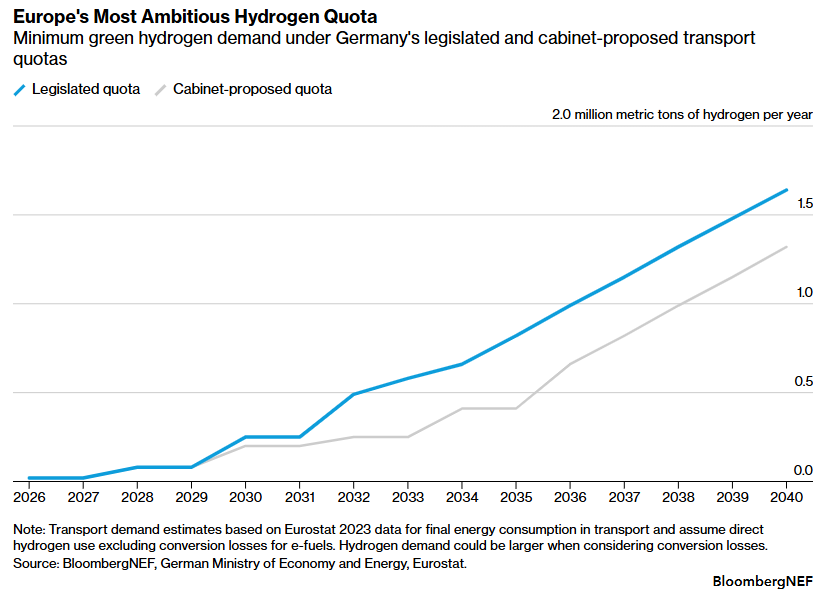
- Mandatory for fuel suppliers to source RFNBO fuels from 2026, starting at 0.1% of transport energy. The mandate rises to ~1.2% by 2030 and 10% by 2040 (200% above the EU requirement).
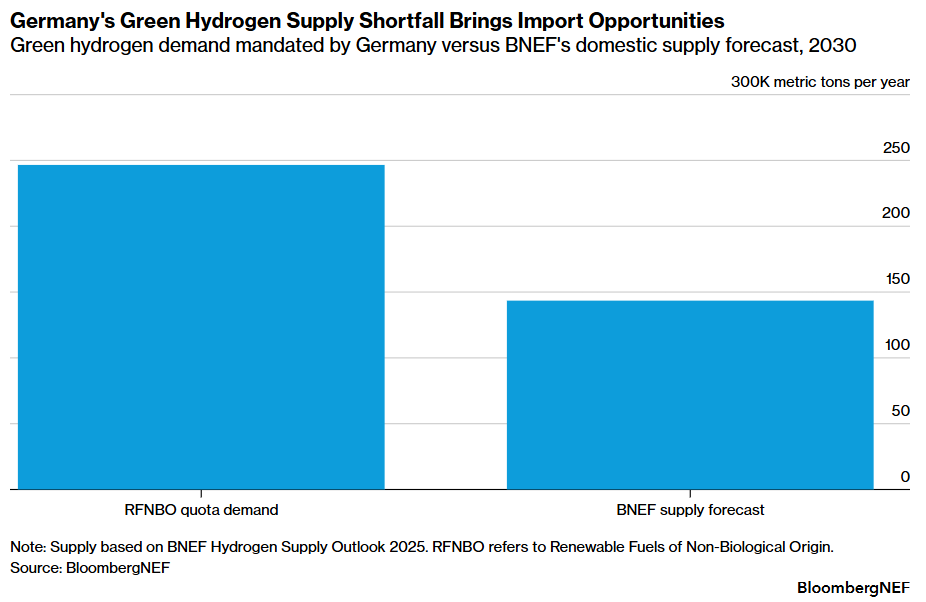
- BloombergNEF estimates that the quotas could drive 250,000 metric tons of green hydrogen demand by 2030 in Germany alone, rising to 1.6 million tons by 2040.
- Germany will not have the supply volume or a competitive price to meet quotas, therefore creating an import requirement of ~100,000 tpa from 2030.
- Fuel suppliers face penalties of €120/GJ if they fail to comply equivalent to a price of €14-15/kg for H2 – creating a strong economic incentive to source compliant hydrogen.
This shifts hydrogen demand from “policy ambition” to legal obligation.
Why this matters: Germany cannot supply this demand domestically
Germany has been clear for several years that imports will be essential to meeting its hydrogen needs. BloombergNEF highlights that:
- European green hydrogen production costs remain structurally high due to power prices, grid constraints and capex (domestic supply costs of €10/kg excluding subsidy).
- Even with strong policy support, Europe is expected to fall well short of domestic production targets by 2030, forcing reliance on imports.
- Primary bottleneck for proposed imports of ammonia remans a lack of “cracking” infrastructure required to convert imported ammonia back into hydrogen for use in the transport sector (not to mention the cost).
Existing grey H2 market impacted… Longspur Research also highlights Germany has had a mandatory greenhouse gas reduction quota in place for transport fuels since 2015, the GHG Quote will now be aligned with RED III. The GHG Quote is estimated to add about €4.5/kg to the price of grey hydrogen to comply and this is seen as setting a floor price of about €7/kg against the RED III cap of €14-15/kg.
Transport mandates favour molecules that can be shipped at lower-cost than domestic supply
Critically, RFNBO obligations apply to physical fuels—not certificates. This creates demand for:
- Reliable, scalable supply chains
- Delivered molecules that meet RFNBO traceability rules
Shipping plays a central role in early hydrogen trade, particularly for markets without completed pipeline infrastructure. A clear opportunity for Nordic hydrogen – delivered by Provaris’ Compressed H2 carriers.
The new German mandate opens a clear window for Nordic hydrogen production:
- Competitive renewable power prices indicate delivered cost estimate of ~€7/kg (subject to power pricing and shipping distance).
- Short shipping distances to German ports.
- Strong alignment with RFNBO certification requirements.
This is where Provaris’ compressed hydrogen shipping solution comes into focus:
- Designed for regional, short‑to‑medium distance routes
- Enables flexible delivery into German ports
- Avoids the conversion losses and reconversion costs associated with hydrogen derivatives such as ammonia.
As Germany’s transport fuel suppliers move to secure early compliant supply, Nordic hydrogen delivered by sea represents a practical and cost‑competitive import pathway.
Bottom line for investors: mandates + limited domestic supply = import demand
- Germany has now locked in hydrogen demand through law (all be it a year overdue).
- German expects imports to fill the gap as domestic supply lags and is expensive. This is what we are hearing directly from German utilities.
- RFNBO mandates favour physical, traceable hydrogen supply – not certificates!
- Nordic‑to‑Germany shipping routes align directly with Provaris’ logistics solution, with delivered RFNBO H2 at half the cost of penalties and inline with current grey H2 costs. No brainer!
This isn’t distant policy ambition — it is near‑term, mandated demand beginning in 2026 and import demand by 2030.